Sourcing a day to dusk conversion service raises questions that go beyond basic pricing. Method type, turnaround window, quality review, and revision coverage all shape what a provider delivers, and those factors vary considerably across the market. For agencies and in-house teams managing listing photography at volume, understanding how each option is structured is what makes provider selection reliable. This article covers the main conversion types, how pricing is built across different production models, and what to consider when matching a service to your output requirements.
I. What a Day to Dusk Conversion Service Involves
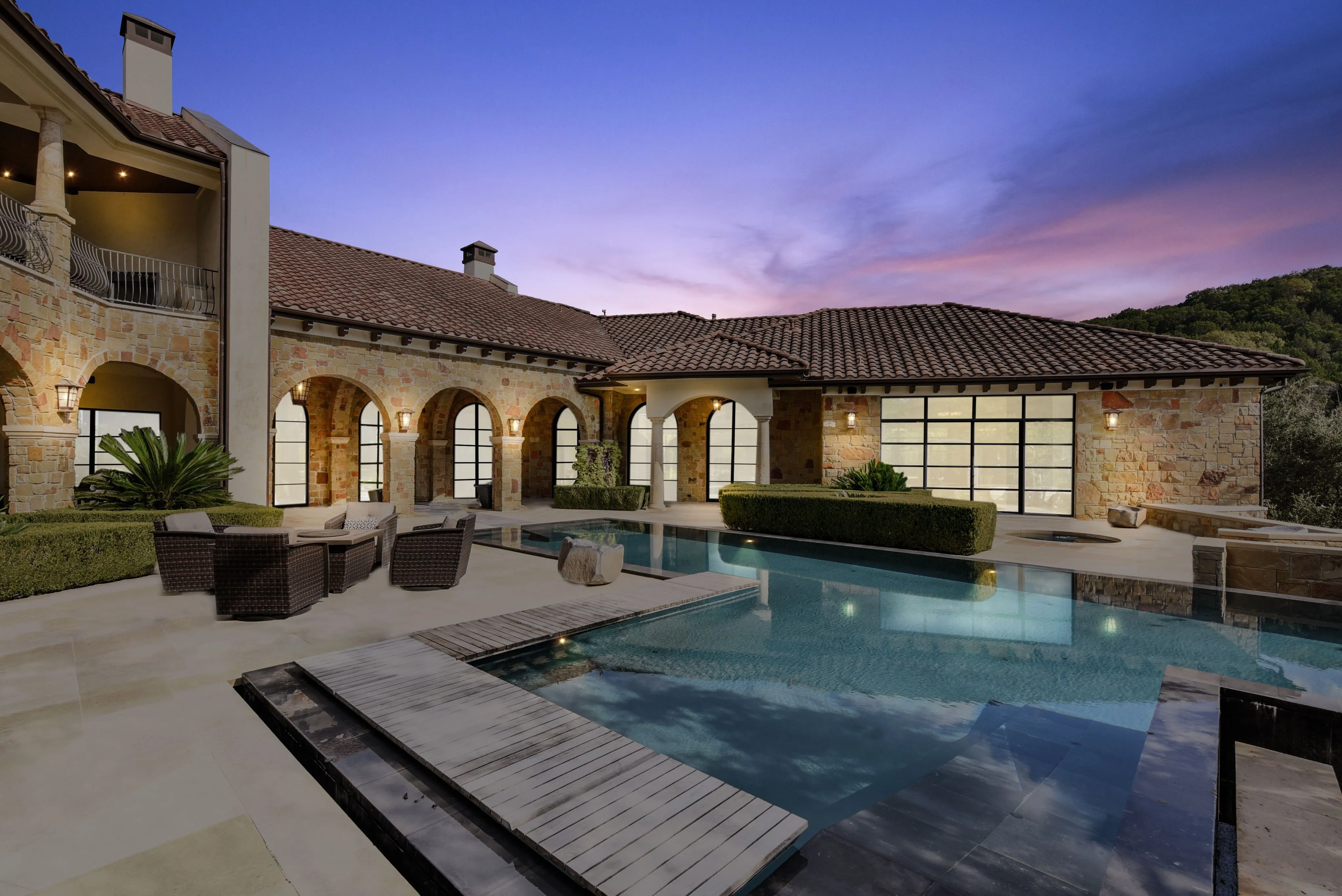
What does a day to dusk conversion service actually involve? It transforms a daytime exterior photo into a dusk scene by replacing the sky, adding window illumination, and adjusting ambient light to simulate the warm, low-light conditions of early evening.
A day to dusk conversion service takes a standard daytime exterior photo and transforms it into a dusk scene through a sequence of targeted edits. The process works across three editing layers that need to integrate cleanly for the final image to hold together.
The Core Technical Steps
Each conversion covers three main components:
Sky replacement: The daytime sky is swapped for a dusk or twilight version, selected and positioned to match the light direction and color temperature of the original shot
Window glow: Interior lighting is added to windows to simulate warmth and occupancy, requiring precise masking to keep the glow contained within the window frame and consistent across the facade
Exterior light simulation: Ambient light levels are adjusted to reflect reduced natural light, including shadow softening, overall tone warming, and subtle lamp or pathway lighting where the scene calls for it
Sky replacement alone produces a partial result. The window glow and exterior light adjustment are what complete the scene.
How the Output Differs from a Real Twilight Photo
A real twilight photo is captured on location during a narrow window after sunset, when natural and artificial light reach a near-equal exposure balance. A converted image approaches the same visual result through editing.
The practical differences come down to scheduling, cost, and consistency across a shoot set. Conversion removes the need for a second site visit and gives the editor direct control over sky tone, window glow intensity, and ambient light level throughout the batch.
See more articles: Best Real Estate Photo Editing Services for the US
Which Property Types and Listing Contexts Benefit Most
The conversion delivers the strongest results in specific conditions:
Properties with visible exterior lighting fixtures, porch lights, or landscape lighting
Listings where the exterior facade is a primary selling feature
Higher-value residential listings where presentation quality directly affects buyer response
Listing sets that require a strong lead image to perform on search portals
Listings with a twilight image as the lead photo see up to 76% more views than those without one (homejab), with twilight photography linked to an average $15,000 addition to sale price (Gitnux). Those gains hold most consistently when the conversion output is clean and integrated well across the full listing set.
II. Types of Day to Dusk Conversion: Manual, AI, and Hybrid
Day to dusk conversion is available across three production methods, each with a different cost structure, turnaround window, and output ceiling. Understanding how each method works allows agencies and in-house teams to match the right approach to a given volume and quality requirement.
Manual Editing
Manual conversion is handled entirely by a human editor working in professional post-production software. The editor selects and integrates the sky, masks and adjusts window lighting, and calibrates ambient tone through direct layer control.
This method applies best to:
High-end listings where output precision carries more weight than turnaround speed
Complex facades with irregular window shapes, reflective surfaces, or detailed architectural features
Shots requiring specific sky styles or brand-aligned color grading
Each image requires significant time investment, and output quality depends directly on the editor's skill level. Manual editing carries the highest cost per image and the longest turnaround of the three methods.
AI-Automated Conversion
AI-automated conversion processes the image through a trained model that handles sky replacement, window lighting, and ambient adjustment without human involvement. The main advantages are speed and cost. Turnaround at volume can run under an hour, and per-image cost is considerably lower than manual production.
The output ceiling is the key variable. AI performs consistently on straightforward images with clean facades and standard window configurations. On more complex shots, it can produce misaligned sky light direction, window glow that bleeds outside the frame, or flat ambient tone. These outputs are workable for high-volume pipelines where images follow consistent input guidelines and speed takes priority over precision.
See more articles: 5 Best Real Estate AI Photo Editor Tools in 2026: Speed, Quality, and Scale
Hybrid Production
Hybrid production combines AI conversion with human quality review and targeted correction. The AI generates the initial output, then a human editor reviews the result and corrects artifacts, adjusts window glow, or refines sky integration where needed.
This approach brings together the practical strengths of both methods:
Turnaround stays closer to AI speed than to manual production
Output quality clears the ceiling AI reaches working alone
Per-image cost sits below manual editing rates
For agencies managing listing photography at volume, with both output quality and delivery speed as active requirements, hybrid production is the most commonly used model.
III. Day to Dusk Conversion Service Pricing: What to Expect Across Provider Types
How is day to dusk conversion service pricing structured across different provider types? Cost is driven by the method used, the level of human involvement, turnaround requirements, and whether quality review and revision are included in the base rate.
Typical Price Ranges by Method
Pricing differs considerably depending on how the conversion is produced:
AI-automated conversion: ranges from $1.50 to $5 per image on pay-per-image models, with subscription-based platforms bringing per-image cost lower at higher volume
Hybrid conversion: typically sits between $5 and $15 per image, with the range reflecting the depth of human QC and correction included in the service
Manual editing: starts around $25 per image for standard professional work and can exceed $150 for complex facades or high-end listing requirements
These figures represent starting points. The actual cost per image shifts based on what the base rate covers.
What Base Pricing Typically Covers
Base pricing across provider models varies considerably in scope:
AI-only providers typically include the conversion output; quality review, artifact correction, and revisions are often priced separately
Hybrid providers generally include one revision round within SLA, though style selection or output validation may carry an additional cost depending on the provider
Manual editing providers include revision within an agreed scope, with further rounds billed separately
Compliance-related infrastructure such as GDPR-aligned file handling is worth confirming upfront, as coverage varies across providers and is less commonly included in standard pricing
How Volume, Turnaround, and Output Guarantees Affect Cost
Three variables consistently shift the final per-image rate across provider types:
Volume: most providers apply tiered pricing above set batch thresholds, reducing per-image cost as order volume increases
Turnaround speed: expedited delivery typically carries a surcharge, particularly for hybrid and manual production
Output guarantees: providers that include QC validation, satisfaction guarantees, or revision within SLA build those costs into their base rate, making the headline price higher and the total cost more predictable
The most reliable comparison point across providers is the all-in cost per delivered image at the required output standard, not the headline rate alone.
See more articles: Day to Dusk Photo Editing for Real Estate
IV. Esoft Virtual Twilight: A Tiered Day to Dusk Solution for Agencies and In-House Teams
With over 20 years of experience in real estate image production, Esoft has built its Virtual Twilight suite around the operational realities agencies and in-house teams work within daily. The three-tier model covers the full range of day to dusk production requirements, with each tier mapped to a specific method type, turnaround window, and quality threshold.
AI Express - $2.50 per image, 1-hour turnaround
Fully automated conversion, no editor involvement
AI day-to-dusk conversion
Interior window lighting and exterior lamp lighting
Day-to-evening adjustment
Original building structure preserved in most cases
Best for: high-volume pipelines where turnaround speed and cost efficiency are the primary requirements
Essential - $5 per image, 12-hour turnaround
All AI Express features included
Human QC before delivery
AI artifact removal
9 style options across warmth and brightness
Revision within SLA boundaries
Best for: standard listing pipelines requiring consistent, listing-ready output with quality validation built in
Premium - $9 per image, 12-hour turnaround
All AI Express and Essential features included
Guaranteed, refined light spill
Guaranteed daytime shadow removal
Window light tone adjustment
Original grass preserved if needed
Bespoke sky library available
Best for: high-end listings where output precision and specialist refinement directly affect presentation quality
Until the end of October, agencies can access 25 complimentary AI Express conversions as a launch offer, providing a direct way to evaluate output quality and turnaround performance against their current production standard before committing at volume.
Esoft holds ISO/IEC 27001 certification and processes all files under GDPR-compliant handling practices. For agencies managing client property assets across an active production pipeline, this means retouching work runs within a security framework that meets enterprise-level compliance standards, with no additional administrative load placed on the agency's own team.
FAQs
How accurate is a day to dusk conversion compared to a real twilight photo?
A converted image closely replicates the visual result of a real twilight shoot. The key difference is production control. Conversion gives the editor direct adjustment over sky tone, window glow intensity, and ambient light across the full batch, producing more consistent output than on-location shooting across multiple properties.
What input quality does a day to dusk conversion require to deliver a clean result?
Clean facade visibility, even daytime exposure, and minimal lens distortion give the conversion the most workable starting point. Overexposed skies, heavy shadows across the building face, or significant distortion add complexity to sky integration and window masking, which affects output quality regardless of the production method used.
When does hybrid conversion justify the higher cost over AI-only production?
Hybrid conversion is worth the added cost when output consistency across a full batch is a delivery requirement. AI alone performs well on straightforward images but produces variable results on complex facades. Human QC added to the workflow catches and corrects those variations before delivery, reducing revision rounds on the agency side.
Key Takeaways
Selecting the right day to dusk conversion service comes down to matching the production method, pricing structure, and output standard to what a listing portfolio actually requires. Manual, AI, and hybrid options each carry a different cost profile and quality ceiling, and the all-in cost per delivered image is a more reliable comparison point than the headline rate alone. Volume, turnaround window, and quality review coverage all feed into that figure. For agencies and in-house teams looking to build a more structured approach to twilight output, reach out to Esoft to discuss the right tier for your pipeline.
Related Blogs

How to Ensure Consistency Across Real Estate Twilight Photos?
Photo Editing
Virtual Dusk Real Estate: Which methods work for your in-house operation?
Photo Editing
How to Achieve Perfect Twilight Real Estate Photography?
Photo Editing

How Virtual Twilight Photos Increase Property Click-Through Rates
Photo Editing

Real Estate Twilight Photo Editing: 5 Features That Matter Most
Photo Editing
Virtual Twilight Photography: Turning Listings into Buyer Magnets
Photo Editing



Linh Phan
Content Strategy Executive
No Spam, Just Updates
Our fresh blogs provide technical and industrial information that helps strengthen your business. Sign up to be the first to receive the new updates
