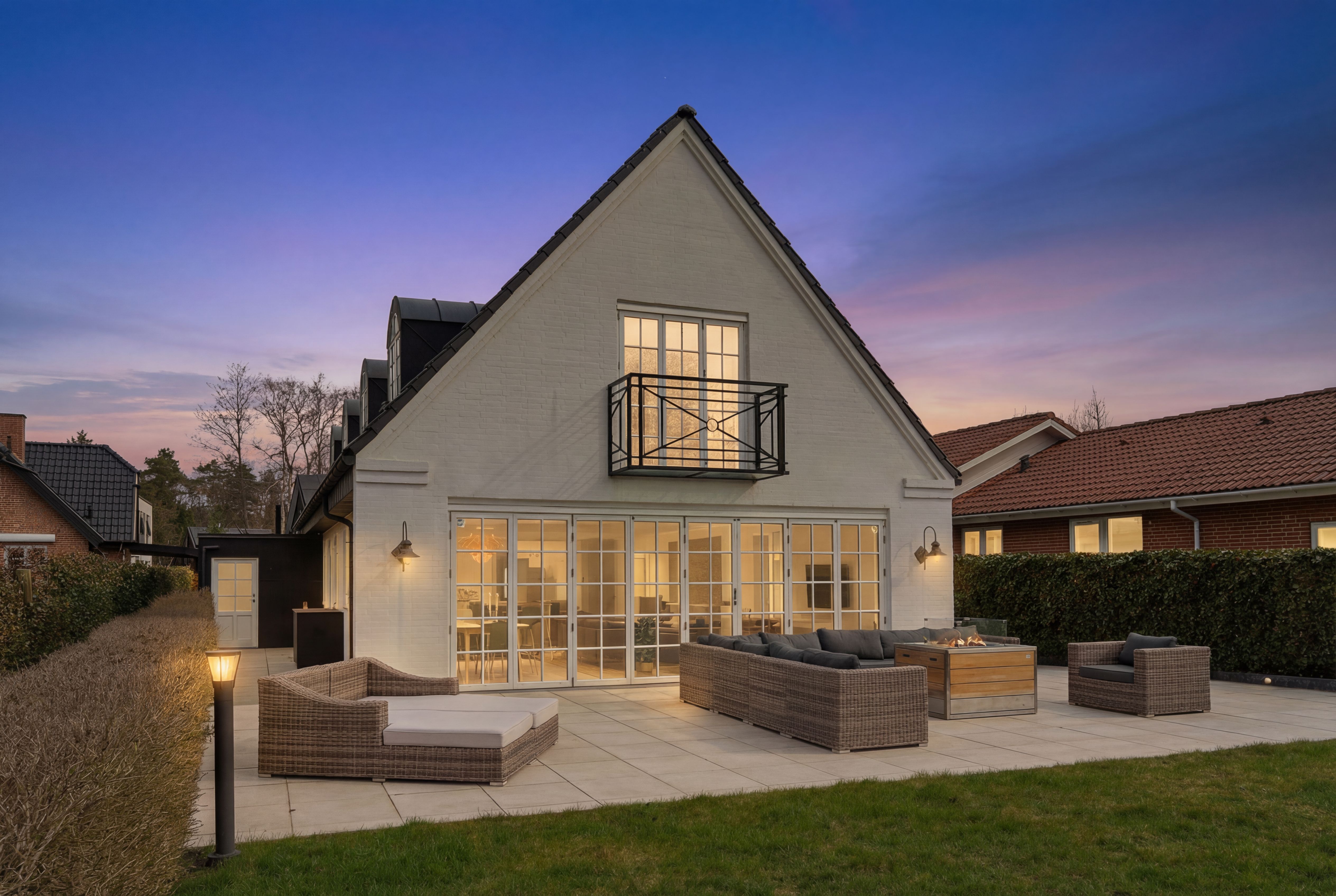
Virtual Twilight photography produces measurable results: higher click-through rates, longer time on listing pages, and stronger buyer inquiry volume. Real estate media professionals managing listings across price points and property types need to understand both the production decisions behind those results and the business case for applying them consistently. This article covers buyer psychology, the real versus virtual production comparison, the six elements that determine image quality, and how to match the right production tier to each listing.
The Buyer Psychology That Makes Twilight Listings Click
Twilight listing images perform better because of how buyers respond to them, not just how they look. Understanding that mechanism helps real estate media professionals make the case for twilight images at every price point.
Warm tones and soft ambient light engage emotional response before rational evaluation begins. A buyer scrolling through search results pauses on an image that feels inviting before they consciously register why. Dusk light creates that pause. The combination of glowing windows, a darkening sky, and lit exterior details communicates something that a flat midday facade cannot: that a real household exists behind that front door.
The data supports this consistently:
Listings using a twilight image as their hero photo average 76% more views than listings without one (Redfin)
Twilight photos increase showings by up to 3x compared to standard daytime exteriors (ShowingTime)
Homes with professional photography, including twilight images, sell 32% faster on average (Redfin)
The listings where twilight imaging delivers the strongest return tend to share specific characteristics:
Slow-moving listings that need renewed buyer attention after sitting on the market
Price reductions where updated photography resets buyer perception
Luxury and premium properties where presentation quality is part of the value signal
New developments where the finished lifestyle needs to be communicated before buyers visit in person
It also works for buyers who will never visit the property at dusk. The emotional response is not about what the home looks like at 7pm; it is about how the image makes the buyer feel about living there.
See more articles: Best Real Estate Photo Editing Services for the US
Real Shoot vs. Virtual Twilight Photography: What Agents Actually Need to Know
Both options can produce strong results, but they operate under very different production conditions. Understanding those differences is what allows agents and media businesses to make the right call for each listing.
The Real Twilight Shoot
A real twilight session produces an authentic result with natural light spill, genuine atmospheric conditions, and real reflections across exterior surfaces. For the right property, that authenticity adds value that is difficult to fully replicate in post-production.
The production constraints, however, are significant:
The usable shooting window is approximately 15 to 20 minutes per session
Weather dependency is high; overcast skies, rain, or strong wind can cancel or compromise the shoot
Rescheduling requires coordinating the photographer, the agent, and the property again
Cost for a dedicated real twilight session typically runs $150 to $400 in most markets, on top of the standard photography fee
Virtual Twilight Photography
Virtual twilight photography works from an image already captured during a standard daylight shoot. There is no return visit, no weather risk, and no narrow timing window to manage. For media businesses handling volume across multiple listings, this changes the production model entirely.
The practical advantages are straightforward:
Any daylight image can be converted, regardless of when it was shot
Turnaround is typically 12 to 24 hours from submission
Cost per image ranges from $20 to $50 for professional editing, compared to $150 to $400 for a dedicated session
Output is consistent across a full listing portfolio, with no variation introduced by changing light conditions
The Quality Gap in 2026
For standard and mid-range residential listings, professional virtual twilight editing now produces results that are indistinguishable from real shoots for the vast majority of buyers. The gap has effectively closed on clean facade images with straightforward architecture.
Real twilight retains a meaningful edge in specific scenarios:
Luxury estates where natural landscape lighting, water features, and outdoor environments are primary selling points
Properties where the surrounding environment, city lights, or natural backdrop is part of the image
Listings where the agent needs the absolute highest level of photographic authenticity for a premium marketing campaign
Matching the Approach to the Listing
The decision comes down to the listing type and the production context. A useful framework:
Scenario | Recommended approach |
High-volume residential portfolio | Virtual twilight |
Standard to mid-range listing, fast turnaround needed | Virtual twilight |
Premium listing, complex architecture | Virtual twilight Premium tier |
Luxury estate with significant outdoor features | Real twilight shoot |
Property with natural surroundings as a selling point | Real twilight shoot |
For most listings in most markets, virtual twilight delivers the visual outcome agents need at a cost and turnaround that fits real-world production workflows. The real shoot remains the right call when the property and the listing budget justify it.
See more articles: 5 Best Real Estate AI Photo Editor Tools in 2026
Six Elements That Separate a High-Converting Twilight Image from a Mediocre One
A technically completed twilight edit and a high-converting one are different outputs. The difference comes down to six production decisions that either hold the realism together or expose the edit to an experienced buyer’s eye.
1. Sky Believability
The light direction on the sky must match the light falling on the facade. A sky rendered by AI without human validation can produce a directional conflict that an attentive buyer will register, even without identifying it consciously. Sky believability is the most common realism failure in virtual twilight output and the first thing a trained editor checks.
2. Graduated Ground Darkening
Driveways, lawns, and landscaping darken at different rates as natural light fades. A flat darkening layer applied uniformly across all ground surfaces is one of the clearest indicators that an edit has not been reviewed. Each material type requires individual treatment to reflect how dusk light actually behaves across an exterior.
3. Window Glow Depth
Warm, multi-source interior light visible through glass tells the buyer that the home is occupied and livable. A flat yellow overlay reads as a production shortcut rather than a convincing interior. Depth and light variation within the window treatment are what make this element work at the buyer psychology level.
4. Facade-Consistent Shadows
Existing shadows cast by eaves, columns, and trees carry structural information about the property’s geometry and original light direction. These need to be retained and adjusted within the new light environment. Removing them strips depth from the image and breaks the internal logic of the edit.
5. Environmental Lighting Details
Pathway lights, porch uplighting, and garden edge lighting add layers of dimension that anchor the edit in a real exterior environment. These details are what separate a flat sky replacement from an image that reads as a complete, considered scene.
6. Restrained Color Grading
Warmth enhances mood and supports the emotional response that makes twilight images effective at the buyer psychology level. Oversaturation pushes the image past the threshold of credibility. The output should read as a property at dusk, not a rendered illustration.
The level of control applied across these six elements is a production decision. AI conversion handles the broad transformation reliably. Whether light spill is guaranteed, whether shadows are removed with precision, whether sky selection is drawn from a controlled library - these outcomes depend on what production steps follow the AI conversion. That distinction is what separates a dusk image someone has checked from one delivered exactly as the AI renders it.
How Esoft’s Three-Tier Virtual Dusk Fits Every Listing Type and Budget
Applying the same level of production effort to every image in a portfolio is a budget allocation problem, not a quality strategy. Esoft’s three-tier Virtual Twilight structure addresses this directly, with each tier adding a production step rather than a different visual outcome. The underlying principle is consistent across all three: every tier runs the same AI conversion. What changes is how much of the production risk Esoft removes before the image reaches the client.
AI Express
AI Express is the fully automated tier built for cost-efficient, high-volume delivery. The workflow runs from AI conversion to output with no manual QC or editor intervention. For agents working at scale across standard residential listings, this tier delivers a compelling dusk image at the lowest possible production cost. The trade-off is consistency. Because no human reviews the output before delivery, quality varies from image to image, AI artifacts are not addressed, and sky, light spill, and shadow treatment all depend entirely on what the AI produces.
This tier fits high-volume residential portfolios where turnaround speed and cost control take priority over guaranteed consistency across every frame.
Standard
Virtual Twilight Standard adds a human QC layer after the AI conversion. An editor reviews each image, removes AI artifacts, validates the output, and applies warmth and brightness adjustments from a set of nine style options before delivery. The result is an image that has been checked against a controlled standard rather than sent directly from the AI pipeline.
Key production characteristics:
Quality assurance is editor-validated and refined before delivery
AI artifacts are controlled and removed
Style control expands to 9 warmth and brightness combinations
Light spill and daytime shadow treatment remain at the AI-generated level
This tier suits mid-range to premium listings where output consistency carries weight and a human review step adds meaningful production value without full specialist editing costs.
Premium
Virtual Twilight Premium adds specialist refinement editing on top of the human QC layer. This is the tier where production accountability extends across every element of the image - not just the broad conversion, but the fine detail that separates a technically passable output from one that holds up under close inspection on a high-value listing.
Key production characteristics:
Light spill is guaranteed and refined, not left to what the AI generates
Daytime shadows are removed with stronger, more precise control
Sky selection draws from a bespoke library with controlled variation
Style control extends to 9 styles plus window light tone options
Where the Standard tier delivers an image someone has checked, Premium delivers an image built to a defined finish. For luxury listings, hero shots, and any property where production detail is visible to buyers, this distinction matters.
FAQs
1. Does a virtual twilight edit look as convincing as a real dusk photo?
When produced with human quality control, yes. The key factors are matched light direction, realistic window glow, and properly darkened ground surfaces. AI-only output can fall short on these details. With specialist refinement, a virtual twilight image is consistently indistinguishable from a photograph taken on location at dusk.
2. Is virtual twilight worth using on every listing, or only premium properties?
It depends on the goal. For standard listings, an AI-processed twilight image adds visual impact at low cost. For high-value properties, the production quality needs to match the listing price. The approach scales - the edit type should simply reflect what that particular listing demands.
3. Why do some virtual twilight images look unconvincing?
Usually because the AI conversion was delivered without review. Common failures include mismatched sky light direction, flat window overlays, and unaddressed daytime shadows. These issues are not inherent to the technique, they are quality control gaps. An editor reviewing the output before delivery catches and corrects all of them.
Conclusion
Virtual twilight photography is not a visual trick, it is a production decision with measurable impact on how a listing performs. The quality of the output comes down to what happens after the AI conversion: whether the image is reviewed, corrected, and built to a defined standard, or delivered as-is. For agents working across listing types and budgets, the right tier is the one that matches the production standard to what the property actually requires. To find the right fit for your workflow, contact our Esoft team.
Related Blogs

Virtual Dusk Real Estate: Which methods work for your in-house operation?
Photo Editing
How to Achieve Perfect Twilight Real Estate Photography?
Photo Editing

How Virtual Twilight Photos Increase Property Click-Through Rates
Photo Editing

Real Estate Twilight Photo Editing: 5 Features That Matter Most
Photo Editing
Twilight Photos Real Estate: AI vs Human Editing
Photo Editing

5 Best AI Photo Editing with Parallel Upload, Postpaid Pricing, Zero Disruption
AI Photo Editing


Linh Phan
Content Strategy Executive
No Spam, Just Updates
Our fresh blogs provide technical and industrial information that helps strengthen your business. Sign up to be the first to receive the new updates